All posts by diviadmin

Small steps to big returns

By Ashish Tyagi, Senior Equity Strategist, Divitas Capital


Confucius, a great Chinese teacher and a philosopher, said that a journey of thousand miles begins with a single step. The journey of personal financial planning is no different from any other journey – one has to get started, the earlier the better. All of us need guidance on managing personal money in order to fulfill goals of leading an outstanding life, pursuing an excellent education and saving for a better life.


Systematic Investment Plan (SIP) is that step, albeit small and steady, in the right direction to accomplish financial goals. Investors are mostly worried about timing the market and tend to wait for an opportune entry point. In many instances, a potential investor may end up not investing at all.


How SIP works?


With SIP, you do not have to worry about market risk and timing because the cost of investment averages out over the duration of your investment horizon. SIP is a financial tool that can create wealth through investment of a fixed amount at pre-decided regular interval, over a period of time. It is easy to understand, convenient to execute and instills discipline amongst investors. In the long run, SIPs can generate high returns even as the financial market rides the waves of volatility.


Benefits of SIP


The biggest advantage of SIPs is that you do not need to time the market. Further it provides twin benefits of power of compounding and rupee-cost averaging. The key benefits are listed below:

  • Disciplined approach to investing
  • Flexibility and convenience
  • Moderate risk
  • Rupee-cost averaging
  • Power of compounding


  • Financial calculators


    It is important for an investor to list down the financial goals and work out a plan with their advisors to achieve the desired goals through SIPs. Financial calculators play a crucial role by estimating the returns on the basis of corpus and tenure. You may visit the Financial Calculator section (http://www.divitascapital.com/private-wealth/financial-calculator) of our website to determine the quantum of savings necessary to achieve your goals.

    The Concept of Financial Risk

    Variance as a measure of risk

    The standard definition of risk according to modern portfolio theory is the measure of variance (or standard deviation) of the portfolio’s return. In the table below, we can see two portfolios with the same average return, yet the individual returns of portfolio “B” are way more varied than portfolio “A”. This is measured statistically as the standard deviation of returns.

    Returns % Portfolio “A” Portfolio “B”
    Year 1 8% 5%
    Year 2 10% 13%
    Year 3 7% -1%
    Year 4 11% 15%
    Year 5 9% 13%
    Average Return 9% 9%
    Standard Deviation 2% 6%

    Systematic vs. Unsystematic risk

    Unsystematic risk
    is simpler to understand. Such type of risks is unique to each of your investments e.g., an investment in a stock or bond of a specific company. This investment will have a specific risk associated with it, specifically the risk associated with the company’s performance and the industry it operates in. It is easy to mitigate this risk by diversifying the portfolio, which basically requires an investor to NOT put all of their “eggs in one basket”.

    Systematic risk
    is a slightly trickier subject; it basically is the risk that is common across the portfolio. For example if all your investments are in equity funds, then your investments are at risk if there is a flight of liquidity from equity markets. Diversification can help here too, but it is important to understand the nature of systematic risk. Say for example you also invest in fixed income funds to diversify risk. The whole portfolio would be at risk if there is a downturn in the economy and companies struggle with operations and debt obligations, resulting in losses in both the debt and equity portfolio. If you had invested in real estate to further diversify risk; remember that these are all Rupee-denominated investments and inflation can wipe away all your real gains in equity, debt and real estate. The moral here is that systematic risk can never be fully eliminated, only minimized.

    Risk from a time perspective

    Another perspective on risk is that of time horizon. Different asset classes show different characteristics over different time horizons. For example, equity fund returns may seem very risky from a time perspective of less than a year as compared to fixed deposit of a similar maturity. A one-year fixed deposit will earn you an assured 6-7%, while equity returns can vary from -20% to +20%. But the same equity asset class looked at from a multi-year perspective will give you 12-15% return averaged over a number of years with a high degree of certainty.

    Additionally, a time related risk is that of business cycles. During times of an economic boom, stock market returns will show phenomenal growth lulling the investor into a false sense of security that this is the status-quo and things will remain as rosy forever. However, this can change very quickly when the economy endures a prolonged slump and returns can be sluggish for years. These cycles can last for 3-4 years in each phase and dent the investor’s portfolio significantly if she is not aware of what is going on and enters and exits at inopportune times. The best way to avoid such pitfall is to remain vigilant during boom times, diversify risk and exhibit patience during slumps to ride out the bearish cycles to generate healthy returns.

    Quantum of risk

    Different financial assets have different quantum of risk associated with them. For example a debt instrument may not exhibit any variance in returns as the payments are fixed but carries a risk of default where an investor can lose all of her capital in one go. While an equity portfolio may lose value more often as the returns are a function of its price; it will typically not lose more than 20-25% in the worst of times for a well diversified portfolio. To understand this risk better, an investor should carry out a Value at Risk (VaR) analysis to determine how much her investments could lose in value in the most adverse circumstances.

    Managing risk

    We now have a basic idea of what risk is. There also exists a rough relationship between risk and return; i.e. higher the risk, higher the potential gain/loss.
    But what does this signify? More importantly, what does it signify for you as an individual investor? The first step any individual should take before starting to invest is to determine her risk profile. Your risk profile depends majorly upon 2 factors.

  • The first is, where you are in life, i.e. what is your age and how many financial responsibilities you have, this helps determine how much to invest, where to invest and for how long.
  • The second is what your risk taking predisposition is, i.e. how conservative or bold you are with your financial investments. This can again be a function of where you are in life but also significantly depend upon your personality type.
  • To summarize, understanding your risk appetite and goals go a long way in allocating capital prudently while avoiding any major investing pitfalls.

    Are you saving enough?

    The most common question that comes up during my client meetings, especially with the younger executives, is whether one is saving enough.  A lot of different formulas or rules of thumb exist however there is no one size that fits all.

    Most of clients that I meet have some form of investments that are generally a result of their random visit to the bank or a recommendation by a friend or relative. Needless to say such ad-hoc approach to investing is value dilutive and reduces the worth of your investments over long period of time.

    I have observed that people worry a lot about their distant future (read retirement) without actually doing anything about it and generally cite unavailability of information and procrastination as the main reasons.

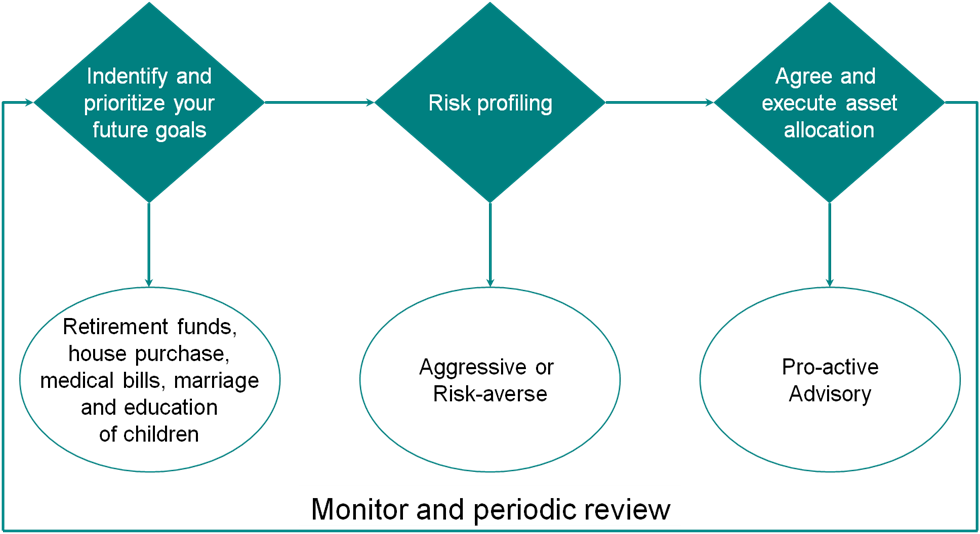
    The primary task before embarking on wealth planning is identifying an investment objective which could be anything from raising a retirement corpus to planning a family holiday or perhaps marriage of the children. With a goal in mind, the time horizon required to achieve your goals can be determined. One cannot stress enough the importance of personal risk preferences – all of us have different appetite for risk and knowing how much risk, one is willing to be exposed to, is a very critical factor in achieving your financial goal.

    Knowledge of your goals, timelines and risk appetite will enable a financial advisor to suggest the best asset allocation strategy. Periodic review with your financial advisor will help you further fine-tune the asset allocation. And sure enough, always keep advisors aware of major changes or life events that may alter your risk profile.

    You can also visit the Goal Setting section (accessible at www.divitascapital.com/private-wealth/risk-profiler) of our website to use financial calculator to determine various quantum of savings necessary to achieve your goals. You can also make use of our risk profiler (accessible at www.divitascapital.com/private-wealth/financial-calculator) to ascertain your risk appetite.

    For example, if you were to buy a house in 10 years time, the down payment for which is about Rs. 50 lakh. Assuming a 13% annual rate of return you will require an SIP of Rs. 20,000 per month or a one-time investment of Rs. 1.4 lakh.

    Feel free to customize these calculations to suit your needs by changing the time period, investment amount, annual rate of return and the required amount.

    The Changing Landscape Of Wealth Management

    Published in Silicon India Consultants Magazine, Jan 2017 issue

    By Ashish Tyagi, Senior Equity Strategist, Divitas Capital

    With increasing number of savvy investors willing to take opportunistic bets and taking the initiative to manage their financial future along with rising globalization, the years ahead will be a game changer for the Wealth Management industry. If you believe there’s a chance of particular stock or mutual fund doing well, you would like to put money in it and take advantage. But how do you find that right stock or the mutual fund and take the investment call? What is needed are sophisticated research tools with financial need analysis along with planning and execution capabilities or a good financial advisor who is committed to manage your financial affairs.

    While most Wealth Management firms currently use fairly simple analysis to deliver the key advice, we expect the firms to develop more descriptive and predictive analysis. As wealth grows, particularly in emerging markets like India, there’s a compelling need for a paradigm shift in the business models of long-established advisory firms. The emergence of new avenues for growth coupled with disruption caused by cyclical headwinds, robo-advisory and uncertainty over the regulatory changes has led to the change in landscape of Wealth Management industry. Thin margins, significant pressure on revenues and cut-throat competition is raising concerns for the small advisors who have large part of their business tied to retail commissions.

    We see an opportunity in emerging markets driven by explosion of wealth to cater the complex needs of High Net-Worth Individuals (HNIs) by serving the mass affluent and HNIs in lower wealth brackets. The enhanced use of technology by the younger generation and young professionals to manage their own investments makes it inevitable for wealth management firms to invest in utility-based models, digital solutions, advice tools and self-service capable websites. The rise of automated advisors, aware and informed investor and willingness of advisors to serve affluent mass segment will result in further consolidation in the industry. The share of unorganized players (typically independent advisors, small brokers/agents) has shrunk considerably over the last few years, primarily due to the increased presence of organized players. Given the nascent stage of the Indian wealth management industry, firms face a shortage of trained advisors. This problem is further aggravated by the mis-selling and wrong advice to churn more and earn higher commissions thereby resulting into an unsatisfied investor. Hence, it is critical for organizations to develop and retain highly qualified team that will be the key differentiator for them.

    As rightly said by Bill Gates, “I believe that if you show people the problems and you show them the solutions they will be moved to act”, this holds true for our wealth management industry as well. Though the landscape is changing, as an advisor, we need to work on our client’s problems and come up with best possible solution as small efforts produce big results.

    BENEFITS OF INVESTING IN TAX SAVING FUNDS

    Mutual funds can be tax-efficient investment avenues that can help reduce your tax burden and at the same time increase your wealth.

    Income tax benefit – Investments made in tax-saving schemes up to Rs 1.5 lakh are eligible for deduction from taxable income under Section 80C of the Income Tax Act.


    Lower lock-in period – In comparison to traditional investment avenues like PPF, NSC under section 80C of the Income tax Act, these funds have the shortest lock in period of 3 years.


    Tax-free dividends/Capital gains – Dividends declared under the tax-saving schemes during the investment period are tax-free. The profits on the sale of these units are treated as long-term capital gains, and are not subject to tax.


    Higher return potential – Tax-saving funds invest a large part of the fund in equity, which despite short-term volatility has the potential to build wealth over the long term.


    WHO SHOULD INVEST?

    • Investors looking for wealth creation over the long term.
    • Investors looking for tax deductions under Section 80C.
    • Investors having a time horizon of 3 years or more.


     Additional Note on Dividend Stripping


    The tax provisions now states that when a person buys any units within a period of three months before the record date, sells such units within nine months after such date, and then the dividend income on such units is exempt from tax. But the capital loss on such sale to the extent of the dividend income cannot be set off against other gains.


    The notional loss caused by the dividend payment can be claimed as loss only if the units were bought three months before the record date or are held for at least nine months after dividend payment. “If the units are sold before 9 months, the loss will be disallowed under Sec 94(7) of the Income Tax Act.”