
All posts by diviadmin

GILT Funds

Most Indians always choose fixed deposits as a way to save money because they are popular and easy to operate. Although they are not as tax-efficient as debt mutuals, fixed deposits can be easily replaced with Gilt Funds if there is no need for steady income flow and the investment horizon is greater than three years.

The FD interest is a yearly addition to the taxpayer’s income that is taxed at the investor’s individual income tax rate. Debt funds outperform FDs tax-wise, particularly for investors in higher tax brackets.

Investments held for less than 36 months that are short-term capital gains in debt funds are taxed like savings deposits (Basis the income tax slab of the investor). After taking into account the benefits of indexation, long-term capital gains in debt funds (investments held for longer than 36 months) are only subject to a 20% tax. When comparing fixed deposit and debt fund taxation, long term capital gain taxation is therefore a significant benefit of debt funds.

Mutual funds known as “Gilt Funds” only invest in government securities. They are favoured by conservative and risk-averse investors who wish to invest in the shadow of government bonds.

Investors are protected from credit risk because gilt funds only invest in government bonds. The instruments in which these funds invest are backed by the government. Therefore, there is no default risk attached to these instruments.

These funds’ maturity profiles can vary. While others are medium or long term, some may be short term. These funds also carry interest rate risk, just like all other bond funds.
Role of Equities in Wealth Creation

By Ashish Tyagi, Senior Equity Strategist, Divitas Capital

Equities though perceived by the masses as the riskiest instrument has its own good attached to its intangible risk. As rightly said by Socrates “Diversification is the key to wealth creation”, and one cannot imagine a diversified portfolio without an equity instrument; equities do play a major role in wealth creation.

In any portfolio, debt is the tool of balancing the risk and volatility whereas equity finds its role in enhancing the return. Though equities come in hand with a relatively higher risk, the incentives do come in hand. As volatility is inherent to equity markets, the risk management approach minimizes the volatility. One should invest regularly and diversify across securities and mutual funds with a long term horizon for investments.

With time on your side, equities inevitably translate into higher gains over long term periods. When invested in a right manner coupled with the power of compounding, equities can result in stellar returns. Several studies have shown that equities, when held over a long term period, aren’t that risky, it’s only on the horizon of 1-3 years that equities show a wide variance and showcases a gloomy future ahead to the investor. The basis of growth of an equity instrument is highly dependent upon the growth of the market index of a country. India has been one of the fastest growing economies of the world showcasing a stellar growth rate of 7%, a similar trend is replicated in case of Nifty which is the index of National Stock Exchange showcasing growth rates much higher than the bank’s fixed deposit rates.

In equities, the risks over a long term period are not that high as perceived by the majority of people. In case of several listed equity shares, the annual growth rates have been exponentially higher than the index growth rate; such equities have proven to be the excellent medium of wealth creation for their shareholders. Apart from an appreciably high growth rate, there are several other advantages which equities offer such as entitlement to dividends, bonus, rights issue and liquidity benefit. Additionally, long term capital gains on any equity instrument are tax-free.

Despite the huge potential for long term wealth creation, most people end up losing money in stocks as they invest their money based on information or tips received from friends and relatives. Lured by the short-term gains, they keep speculating as to what will happen next and they pick wrong stocks that lead to large losses and eventually they start avoiding markets. Thus, the role of an Independent Financial Advisor becomes important. A good advisor helps you develop realistic expectations about the risks and rewards of each investment by avoiding the common pitfalls that are the cause of losses for most investors who invest on their own.

Like all the good things in life, even wealth creation takes its own sweet time. The sooner you begin, the better.

Dealing with rate cut on your savings and deposit account?

RBI announced cut in repo rate by 25 basis points to 6% on 2nd August. Recently HDFC Bank, ICICI Bank, PNB, and SBI have cut their savings rate by 50 basis points to 3.5% from 4.0%, the lowest in six years. The cut seemed imminent on the back of large inflows in savings and current accounts during demonetization period in November & December 2016.

Effective return on FD has become nil!
As the fixed deposit rates fall, retirees and other investors who rely heavily on the bank fixed deposits as their income/savings avenue have been hit the most. Bank FD returns are fully taxable too. An investor in the highest income slab, a 7.25 percent return translates into a 5 percent post-tax return. Since inflation is hovering around the same figure, the real return is almost zero. Fixed income products, at best, are merely capital preserving in nature and not meant for wealth creation.

Mutual funds have superior risk-return portfolio
Mutual funds offer a large basket of products for both the risk-averse and risk-seeking investors. For a marginally higher risk, a risk-averse investor can earn significantly higher returns in Debt Mutual Funds (Read more: www.divitascapital.com/debt-mutual-funds). Similarly, Equity Mutual Funds can generate a higher marginal rate of return on a marginal increase of risk. Historically well-managed equity mutual funds have generated an annual return in mid-to-high double digits over a long time horizon. While investors face re-investment challenge in fixed deposit instruments, with mutual funds, the money stays invested as long as it gets redeemed.

Choice of products and continuous appraisal is critical to successful wealth planning
There are hundreds of schemes to invest into but there are 3 critical factors that go into the choice of products: 1: Risk appetite, 2: Financial goals and 3: Time horizon. A prudent investment advisor will regularly monitor your portfolio and suggest adjustments according to the changes in the economy and market conditions or to any new developments in your personal life.

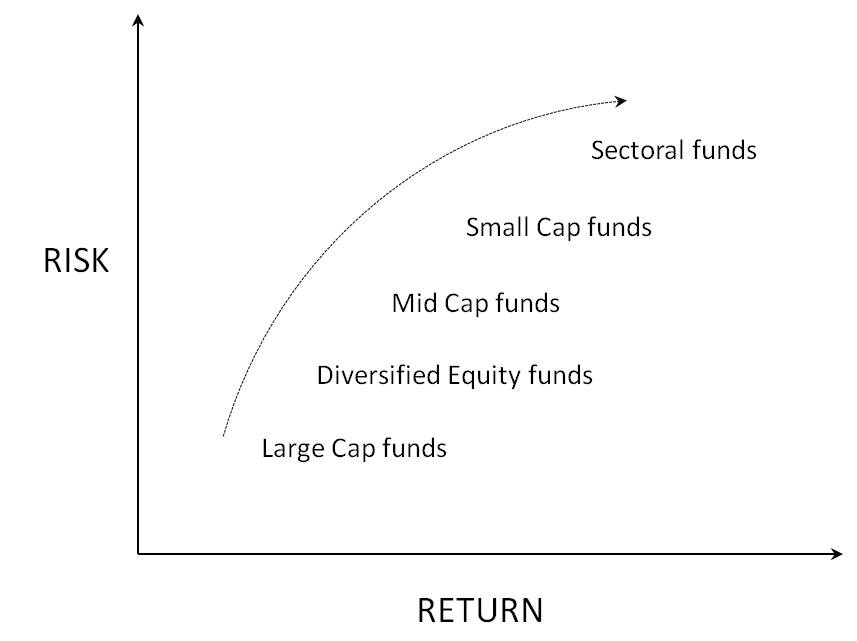
Refer to the following illustration as a guide to a risk-return matrix for Equity Mutual Funds:


Only for illustration purposes and not to be construed as indicative yields/returns of any MF schemes.

Debt Mutual Funds

There are a large number of instruments that an investor can choose to invest in. Many factors go into determining the right product but primary considerations are investor’s risk appetite and time to payout. Debt Mutual Funds are a good choice of investment for individuals who want medium return at low risk.

Debt mutual funds mainly invest in a mix of debt or fixed income securities such as Treasury Bills, Government Securities, Corporate Bonds, Money Market instruments and other debt securities of different time horizons. For the risk-averse investors debt mutual funds are better alternatives to fixed deposits due to following reasons:

HIGHER LIQUIDITY AND FLEXIBILITY THAN FD
Debt mutual funds have higher liquidity – you can withdraw your investment in part or in full and the money will be credited to your account the next day. Debt funds are also more flexible than fixed deposits since you can invest small amounts every month by way of an SIP or whenever you have surplus cash. Opening a fixed deposit every time you have some extra cash in your bank account is impractical. Additionally by moving your money into debt funds, you don’t lose a day’s growth.

TAX EFFICIENT
In the long term, debt funds are far more tax efficient than fixed deposits. Income from investment above one year is treated as a long-term capital gain and is taxed at either 10% or at 20% after indexation. Income from fixed deposits is taxed on an annual basis whereas in debt funds, the tax is deferred indefinitely till the units are redeemed.

RETURNS CAN BE HIGHER
The pre-tax returns from debt funds are comparable with those from other debt options such as fixed deposits and bonds. Short-term debt funds are not affected too much by interest rate changes in the economy and investors continue to gain from the accrual of interest. But funds that invest in long-term bonds are more sensitive to changes in interest rates. If interest rates decline, the value of the bonds in their portfolio shoots up, leading to capital gains for the investor.

If you wish to discuss more about investment opportunities in Debt Mutual Funds, please write to us at gurmeet@divitascapital.com

Make your money work hard

By Charanjit Basumatary

Earlier we posted the SEBI survey finding on the investing habits in India. I decided to conduct a similar study within my group of friends. They are successful professionals – senior engineers, executives and mid-level managers at reputed companies, yet they had little idea about their personal finance. Most of them had investments only in Fixed Deposits and PPFs. This trend was very similar to the one in SEBI survey. From my conversations, I found that there were 3 main reasons for such trend –

  • Investment habits passed down from parents/family
  • Society advocates risk-aversion
  • Busy weekdays and lazy weekends
  • Habits passed down from parents/family

    Parents play an important role in our personal finances – most of my friends claim to have invested in FD accounts because their parents suggested doing so; the remaining ones conceded that FD investment seemed like a natural choice as in the case of their parents. What worked during the times of our parents does not necessarily function in the same manner today. Financial markets are highly developed and liquid now, and regulations are much tighter for the sake of investor protection.

    Our propensity to risk aversion

    Engaging in a risky activity goes against the standard societal practice. None of us want to end up as the only fool in the bunch. We tend to relegate everything other than FDs and PPFs as risky while failing to understand that FDs and PPFs generate investor returns in a similar mechanism as mutual funds do, albeit the returns can differ significantly.

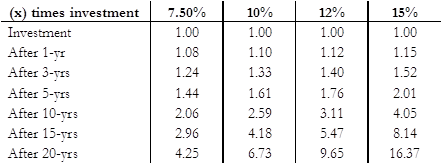
    Over longer time horizon, mutual funds comfortably and consistently beat FD and PPF investment. The implication of this is huge – as illustrated in the table below, your lump sum investment of 1 unit in FD would yield 4.2x after 20 years, compare that to 9.6x return in case of mutual fund with 12% CAGR. You may ask – 12% year-on-year growth for 20 years, do such funds even exist? As a matter of fact, oldest running blue chip mutual funds have generated more than 15% CAGR over the period of 15 years.


    &nbsp&nbsp&nbsp&nbsp&nbsp&nbsp&nbsp&nbsp&nbsp&nbsp&nbsp&nbsp&nbsp&nbsp&nbsp&nbsp&nbsp&nbsp&nbsp&nbsp&nbsp&nbsp&nbsp&nbsp&nbsp&nbsp&nbsp&nbsp&nbsp&nbsp&nbsp&nbsp
    Table: Compounding returns at different rates and investment horizon

    Our modern lifestyle

    All of us complain about being too busy on the weekdays, naturally we reserve our weekends for less stressful activities. Planning personal finance is no doubt an intensive process; however every weekend gone is an opportunity missed.

    Contact an expert on personal finance, educate yourself on various investment options and start investing early to exploit the phenomenon of compounding returns. Although many alternatives are available, SIP investments in mutual funds work the best for retail investors. Amongst many reasons, the most important is that your money is being managed by professional investors who work 24×7 while you can enjoy worry-free weekends.

    To sum up, we work very hard for money, now it’s time for our money to work hard.